Buy klicks.eu ?
We are moving the project
klicks.eu .
Are you interested in purchasing the domain
klicks.eu ?
domain@kv-gmbh.de · 0541-91531010
Buy klicks.eu ?
What is the SQL SELECT query?
The SQL SELECT query is used to retrieve data from a database. It allows you to specify which columns you want to retrieve and which rows you want to filter based on certain conditions using the WHERE clause. The SELECT query is one of the most commonly used SQL commands and is essential for querying and retrieving information from a database. **
What are the basic SELECT statements in SQL?
The basic SELECT statements in SQL are used to retrieve data from a database. The most basic form of a SELECT statement is "SELECT * FROM table_name", which retrieves all columns and rows from a specified table. Another basic form is "SELECT column1, column2 FROM table_name", which retrieves specific columns from a table. Additionally, the SELECT statement can be combined with other clauses such as WHERE, ORDER BY, and GROUP BY to further filter and sort the retrieved data. **

Similar search terms for SQL
Top-Angebote
Products related to SQL:
-
All Categories Goods Universal Car Rear View Mirror, Click On, Wide Angle Convex, Panoramic Rearview, Anti Glare Universal Car Rear View Mirror, Click On, Wide Angle Convex, Panoramic Rearview, Anti GlareEnhance your driving experience with the Universal Car Rear View Mirror, designed to provide a wide angle convex view that effectively eliminates blind spots. This panoramic rearview mirror offers a clearer, safer, and more comfortable driving...42,97 $*Shipping: 0,00 $Secure redirect to the provider
-
Wine.com """Explore Sonoma""""""This highly rated Sonoma set showcases the region’s diversity and depth. Featuring expressive Pinot Noir, opulent Chardonnay, and a balanced Red blend. It’s a curated journey through Sonoma’s most celebrated terroirs. Schug Sonoma Coast Pinot Noir..."99,99 $*Shipping: 0,00 $Secure redirect to the provider
-
KitchenCuration Cool One Click Butter Cutter Cool One Click Butter CutterFor those who love indulging in garlic bread, toast, mac and cheese, or mashed potatoes, but hate the hassle of slicing butter, this oneclick butter cutter stick is the solution you've been looking for. This innovative device slices butter with...22,97 $*Shipping: 0,00 $Secure redirect to the provider
-
Wine.com """Explore Napa Valley Trio - California""""""Each highly-rated bottle in this set has been carefully selected to exemplify the quintessential Napa Valley characteristics, offering a tasting experience that is both memorable and distinctive. Whether a seasoned oenophile or a curious novice,..."119,99 $*Shipping: 0,00 $Secure redirect to the provider




-
Can I output an SQL SELECT statement separated by commas?
Yes, you can output an SQL SELECT statement separated by commas. When you write a SELECT statement in SQL, you can list multiple columns separated by commas to retrieve specific data from a table. For example, you can write a statement like "SELECT column1, column2, column3 FROM table_name" to retrieve data from the specified columns in the table. The commas are used to separate the column names in the SELECT statement. **
-
How can I display the decimal places in an SQL SELECT?
To display decimal places in an SQL SELECT statement, you can use the ROUND() function. For example, if you have a column named "price" and you want to display it with 2 decimal places, you can use the following query: SELECT ROUND(price, 2) FROM table_name. This will round the "price" column to 2 decimal places in the result set. **
-
What is the order for executing a SELECT statement in SQL?
The order for executing a SELECT statement in SQL is as follows: 1. FROM: The query starts by specifying the table or tables from which to retrieve data. 2. WHERE: Any conditions for filtering the data are applied next, using the WHERE clause. 3. GROUP BY: If necessary, the data can be grouped using the GROUP BY clause. 4. HAVING: Conditions for filtering the grouped data can be applied using the HAVING clause. 5. SELECT: The columns to be retrieved are specified using the SELECT clause. 6. ORDER BY: Finally, the data can be sorted using the ORDER BY clause. **
-
How can one rewrite SQL questions into SQL commands?
To rewrite SQL questions into SQL commands, one can start by identifying the specific data that needs to be retrieved or manipulated. Then, the question can be translated into SQL commands such as SELECT, INSERT, UPDATE, or DELETE, depending on the specific task at hand. It's important to ensure that the SQL commands are structured correctly and include the necessary clauses such as WHERE, GROUP BY, or ORDER BY to achieve the desired outcome. Additionally, one should consider any necessary joins or subqueries to retrieve data from multiple tables. **


What is SQL and what does an SQL server do?
SQL, or Structured Query Language, is a programming language used to manage and manipulate data in relational databases. It allows users to create, retrieve, update, and delete data from databases, as well as define and manipulate the structure of the data. An SQL server is a software application that is used to store and manage databases, allowing multiple users to access and manipulate the data concurrently. It provides a secure and efficient way to store and retrieve data, and can handle large volumes of data and complex queries. **
How can I write an SQL command to select by birth month?
To select by birth month in SQL, you can use the `MONTH()` function to extract the month from the birth date column and then use it in the `WHERE` clause to filter the results. For example, if you have a table called `employees` with a column `birth_date`, you can write the SQL command as follows: ```sql SELECT * FROM employees WHERE MONTH(birth_date) = 5; ``` This command will select all the employees whose birth month is May (which is represented by the number 5). You can replace 5 with any other month number to select employees born in a different month. **
Top-Angebote
Products related to SQL:
-
Microsoft SQL Server 2019 Standard (CAL) - Full licenceMicrosoft SQL Server 2019 Standard (CAL) - Full licence Microsoft SQL Server 2019 Standard (CAL) is the ideal solution for companies and professionals looking for a powerful, secure and highly scalable database. This edition offers all the fundamental functionalities to reliably manage, store and analyse data, guaranteeing high performance and business continuity. Thanks to the licence model Server + CAL (Client Access Licence) , you can easily manage user or device access, while maintaining full control over costs and security. Main features High performance: Intelligent query optimisation and better support for complex workloads. Maximum security: Advanced features such as Always Encrypted, Data Classification and auditing to protect your data. Enhanced integration: Compatible with business intelligence, data analysis and machine learning tools. High availability: Support for failover and replication clusters to minimise downtime. Flexible scalability: Ideal for SMEs and growing companies that need a stable, high-performance infrastructure. What the licence includes Licence SQL Server 2019 Standard Model Server + CAL Suitable for Windows Server environments Immediate activation and dedicated technical support For whom it is ideal Companies in need of a secure and high-performance database platform IT professionals and developers Organisations requiring precise access control via CALs ERP solutions, CRM, management and mission-critical applications87,99 £*Shipping: 0,00 £Secure redirect to the provider
-
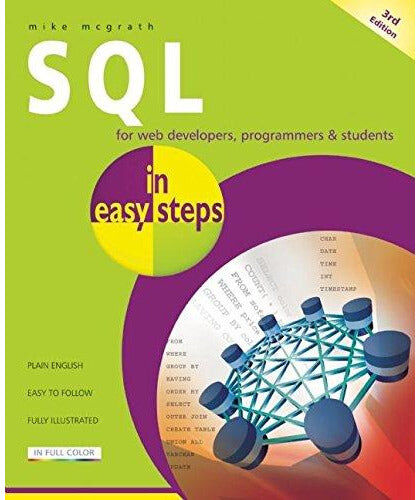
In Easy Steps Limited SQL In Easy Steps 3rd EditionSQL in easy steps, 3rd edition has an easy-to-follow style that will appeal to anyone who wants to begin using databases. It is aimed at those with little or no experience of SQL. From web developers wanting to add database interaction to their web sites, programmers wanting to quickly add SQL to their skills set, hobbyists who want to begin creating SQL scripts for upload to their own ISP, to students or to those seeking a career in computing, this book will appeal to all who need a fundamental understanding of database administration with SQL. SQL in easy steps, 3rd edition begins by explaining how to download and install the free MySQL database server on both Windows and Linux platforms. This allows you to establish an environment in which to develop and administer your own databases. This book makes no assumption that you will have previous knowledge of any programming or scripting language so it's ideal for the newcomer to SQL. Each chapter builds your knowledge of executing database queries. The book contains exciting chapters on how to selectively extract data from within one, or more, databases and there are complete examples that illustrate each aspect of SQL. By the end of this book you will have gained a sound understanding of the Structured Query Language and be able to write your own SQL scripts to insert, extract and manipulate data. Updated and revised with the latest techniques since the second edition, which was published in 2005. All examples given in this 3rd edition demonstrate SQL features using the MySQL Relational Database Management System that is supported on both Windows and Linux operating systems. Table of Contents Introducing SQL Getting Started Creating database tables Inserting data into tables Retrieving data from tables Sorting retrieved data Simple data filtering Complex data filtering Generating calculated fields Manipulating data Grouping table data Making complex queries Joining database tables5,49 £*Shipping: 2,99 £Secure redirect to the provider
-
All Categories Goods Universal Car Rear View Mirror, Click On, Wide Angle Convex, Panoramic Rearview, Anti Glare Universal Car Rear View Mirror, Click On, Wide Angle Convex, Panoramic Rearview, Anti GlareEnhance your driving experience with the Universal Car Rear View Mirror, designed to provide a wide angle convex view that effectively eliminates blind spots. This panoramic rearview mirror offers a clearer, safer, and more comfortable driving...42,97 $*Shipping: 0,00 $Secure redirect to the provider
-
Wine.com """Explore Sonoma""""""This highly rated Sonoma set showcases the region’s diversity and depth. Featuring expressive Pinot Noir, opulent Chardonnay, and a balanced Red blend. It’s a curated journey through Sonoma’s most celebrated terroirs. Schug Sonoma Coast Pinot Noir..."99,99 $*Shipping: 0,00 $Secure redirect to the provider
-
What is the SQL SELECT query?
The SQL SELECT query is used to retrieve data from a database. It allows you to specify which columns you want to retrieve and which rows you want to filter based on certain conditions using the WHERE clause. The SELECT query is one of the most commonly used SQL commands and is essential for querying and retrieving information from a database. **
-
What are the basic SELECT statements in SQL?
The basic SELECT statements in SQL are used to retrieve data from a database. The most basic form of a SELECT statement is "SELECT * FROM table_name", which retrieves all columns and rows from a specified table. Another basic form is "SELECT column1, column2 FROM table_name", which retrieves specific columns from a table. Additionally, the SELECT statement can be combined with other clauses such as WHERE, ORDER BY, and GROUP BY to further filter and sort the retrieved data. **
-
Can I output an SQL SELECT statement separated by commas?
Yes, you can output an SQL SELECT statement separated by commas. When you write a SELECT statement in SQL, you can list multiple columns separated by commas to retrieve specific data from a table. For example, you can write a statement like "SELECT column1, column2, column3 FROM table_name" to retrieve data from the specified columns in the table. The commas are used to separate the column names in the SELECT statement. **
-
How can I display the decimal places in an SQL SELECT?
To display decimal places in an SQL SELECT statement, you can use the ROUND() function. For example, if you have a column named "price" and you want to display it with 2 decimal places, you can use the following query: SELECT ROUND(price, 2) FROM table_name. This will round the "price" column to 2 decimal places in the result set. **
Similar search terms for SQL
-
KitchenCuration Cool One Click Butter Cutter Cool One Click Butter CutterFor those who love indulging in garlic bread, toast, mac and cheese, or mashed potatoes, but hate the hassle of slicing butter, this oneclick butter cutter stick is the solution you've been looking for. This innovative device slices butter with...22,97 $*Shipping: 0,00 $Secure redirect to the provider
-
Wine.com """Explore Napa Valley Trio - California""""""Each highly-rated bottle in this set has been carefully selected to exemplify the quintessential Napa Valley characteristics, offering a tasting experience that is both memorable and distinctive. Whether a seasoned oenophile or a curious novice,..."119,99 $*Shipping: 0,00 $Secure redirect to the provider
-
Wee Gallery Explore Playmat - Multi-ColorDesigned With Care: Wee Gallery's infant playmat features a hand-illustrated woodland scene on one side and a neutral cityscape on the other. Measuring 40 inches in diameter, our play mat creates the perfect area for cushioned play and baby...98,95 $*Shipping: 0,00 $Secure redirect to the provider
-
What is the order for executing a SELECT statement in SQL?
The order for executing a SELECT statement in SQL is as follows: 1. FROM: The query starts by specifying the table or tables from which to retrieve data. 2. WHERE: Any conditions for filtering the data are applied next, using the WHERE clause. 3. GROUP BY: If necessary, the data can be grouped using the GROUP BY clause. 4. HAVING: Conditions for filtering the grouped data can be applied using the HAVING clause. 5. SELECT: The columns to be retrieved are specified using the SELECT clause. 6. ORDER BY: Finally, the data can be sorted using the ORDER BY clause. **
-
How can one rewrite SQL questions into SQL commands?
To rewrite SQL questions into SQL commands, one can start by identifying the specific data that needs to be retrieved or manipulated. Then, the question can be translated into SQL commands such as SELECT, INSERT, UPDATE, or DELETE, depending on the specific task at hand. It's important to ensure that the SQL commands are structured correctly and include the necessary clauses such as WHERE, GROUP BY, or ORDER BY to achieve the desired outcome. Additionally, one should consider any necessary joins or subqueries to retrieve data from multiple tables. **
-
What is SQL and what does an SQL server do?
SQL, or Structured Query Language, is a programming language used to manage and manipulate data in relational databases. It allows users to create, retrieve, update, and delete data from databases, as well as define and manipulate the structure of the data. An SQL server is a software application that is used to store and manage databases, allowing multiple users to access and manipulate the data concurrently. It provides a secure and efficient way to store and retrieve data, and can handle large volumes of data and complex queries. **
-
How can I write an SQL command to select by birth month?
To select by birth month in SQL, you can use the `MONTH()` function to extract the month from the birth date column and then use it in the `WHERE` clause to filter the results. For example, if you have a table called `employees` with a column `birth_date`, you can write the SQL command as follows: ```sql SELECT * FROM employees WHERE MONTH(birth_date) = 5; ``` This command will select all the employees whose birth month is May (which is represented by the number 5). You can replace 5 with any other month number to select employees born in a different month. **
* All prices are inclusive of VAT and, if applicable, plus shipping costs. The offer information is based on the details provided by the respective shop and is updated through automated processes. Real-time updates do not occur, so deviations can occur in individual cases. ** Note: Parts of this content were created by AI.